Children of a Lesser God Ep 13 K Drama Review
theater review
Theater Review: Listening to Children of a Lesser God, 30 Years Later
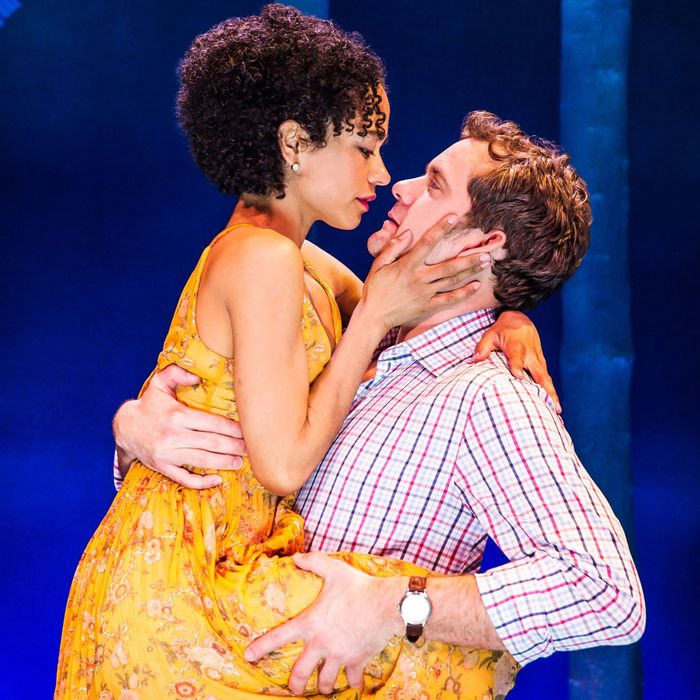
Lauren Ridloff and Joshua Jackson in Children of a Bottom God, at Studio 54. Photo: Matthew Tater
There are ii intense scenes in Children of a Bottom God's first Broadway revival, opening this evening at Studio 54 almost 30 years later on its Tony-sweeping debut, that are already reason enough to see it. In the showtime showstopper, late in Act One, Sarah Norman — deaf from birth and mute by choice — uses sign language to explain what her silence "sounds" like to her teacher and future lover. Sarah's long fingers flutter and bloom similar gestural fireworks, pure transmission lyricism. And then, toward the end of the play, there is Sarah's single eruption of speech, a long and angry roar from the depths of that silence as primal and disturbing as anything in Lear.
These twin climaxes have a couple of things in common. Both are performed with instinctive luminescence by interim rookie Lauren Ridloff, a former Miss Deaf America who was teaching ASL to the play'due south director, Kenny Leon, when he had a stroke of casting genius. And both scenes happen to be incomprehensible to the hearing audience, or at least those without a re-create of the script. Broadway's most accessible evidence e'er for the hearing-impaired is at times inaccessible or awkward for the hearing — which is perhaps the near thematically resonant technical flaw ever to afflict a play.
James Leeds, an able-hearing teacher played with grace under tremendous force per unit area past Joshua Jackson (who has to sign his spoken lines and then voice Sarah'southward replies), falls in dearest with the 26-year-quondam Sarah, an alumna and current housekeeper at their residential school for the deaf. James is convinced that learning to speak and lip-read volition open up up the world to his highly intelligent educatee, but Sarah considers it a class of selling out. James insists she'southward only scared, sheltering herself in the persona of the "deaf aroused person." Sarah was idea to exist retarded until age 12; her deafness broke upward her parents' wedlock and her female parent (Kecia Lewis) sent her away at historic period 5. Lewis plays Mrs. Norman with coiled volatility, hinting at the way shame might have twisted into deep resentment in mother and girl both.
Against all odds and the sage advice of headmaster Mr. Franklin (played with weary wit by Anthony Edwards), the lovers marry and a few too many complications ensue. Mark Medoff's 1979 play might have won 3 Tonys (for Best Play and both leads), along with an Oscar for Marlee Matlin in its gauzy 1986 film accommodation, simply it's no masterwork of plot. It's a loose memory play recounted by an older James — giving him complete narrative control over a story in which he'south already translating all of Sarah's signs for us. ("No one is ever going to speak for Sarah over again," he says, speaking for Sarah yet once more.)
Leon'south direction leans into the play'due south historic period as well equally its loose plotting. Dede Ayite's costume designs — bong bottoms embroidered with flowers, blazers and clogs and ruffled bright blouses — are impeccable, if maybe a little too sinuous and vibrant on Sarah, a virtual close-in. The songs, from Prince and Wings and World Wind & Burn, are all meticulously carbon-dated, but none feels gimmicky or rote. (This is reportedly an comeback from last summer'south Berkshire Theatre Group tryout, though the replacement of Stephen Spinella as the headmaster is surely a loss.) Music plays a surprisingly powerful office in this narrative well-nigh silence — as when James egregiously soundsplains a Bach concerto, creating another cleft in the couple's unstable marriage.
Derek McLane's minimalist set admits but a few chairs, several oversize door frames lit in ever-irresolute hues, and a handful of existent props. Supporting players waltz on and off virtually willy-nilly — chiefly the young, flirty student Lydia (Treshelle Edmond, who can't transcend her character's frivolousness), and more importantly Orin, Sarah'southward babyhood friend (a passionate John McGinty), who enlists her grudging support in a lawsuit demanding more deafened teachers at the school.
Lydia and Orin, nearly deaf students whom James has taught to speak imperfectly, also function to fill in the spectrum of speech and hearing, throwing James and Sarah into relief. (The fact that Ridloff is African-American underscores their power dynamic.) McLane'due south sparseness heightens the sense of their romance equally both extraordinary and fleeting, though sometimes at the price of naturalism. The couple's start dinner date feels about as authentic as an Italian-restaurant sketch on Sat Dark Alive.
And yet their chemistry is undeniable. Ridloff is not only a cracking silent actress simply likewise a fantastic flirt. Jackson has to piece of work a little harder (by and large with success) to expose the tender heart of a graphic symbol with more than contradictions. On summit of all the talking and signing, James needs to exist both loving and controlling, a Peace Corps do-gooder who emotionally abandoned his troubled mother. It's his bafflingly insensitive reaction to i of Sarah'southward concluding monologues — a prepared speech communication in which she meditates eloquently on the sign for "union" — that leads to their climactic fight.
Some of James's willful obtuseness might be an artifact of a time when it was more than normal for a teacher to stalk a student unto marriage, remove her from dwelling house and job, and hope to fulfill her every desire except the ane she holds most beloved — in this case the correct to remain silent. Sarah'southward push for independence must have felt more than stubborn and shocking back when deafened people were expected to adjust the hearing and women to accommodate men. (Men who uttered icky Me Decade psychobabble like "I need to exist ingested by yous.")
More significant than the dated language or sexual politics is the play's core trouble, which is also the problem of its characters. Sarah complains that hearing people who neglect to respect her speechlessness "will never truly exist able to come up inside my silence and know me." Well, neither tin can we — barring some major rewrite that might let us, for instance, to read her words in supertitles instead of pausing the activity equally James recites them. In fact, Studio 54 already displays supertitles, only they're for the hearing-impaired — printing what's spoken merely not what'due south signed. And well-nigh that first bully scene: The script translates Sarah's beautiful description of her ain silence as "the audio of spring breaking upwardly through the death of winter." Information technology'due south just as cute in Ridloff's signing hands, merely it would exist prissy to know the literal meaning, too.
And nevertheless there is ability in the untranslated, which of grade is the point. Logistical concerns vanish in the play's best moments. Gone is the sense that this is an obligatory Worthy play, or a Terms of Endearment–style weepie in the mode of the film. You may, in fact, cry, but only in mourning for everything that separates Sarah and James — or anyone from anyone else. Medoff's real subject isn't deafness or even love, only the problem of other minds, and the impossibility of forging that perfect union we all long for, whereby a couple can become one, and yet remain two at the same time.
Children of a Lesser God is at Studio 54.
Source: https://www.vulture.com/2018/04/theater-review-listening-to-children-of-a-lesser-god.html
0 Response to "Children of a Lesser God Ep 13 K Drama Review"
Post a Comment